Monday, 20 April 2026

Tailored, not bespoke

I was mulling over a posting on this topic in any event, but an exchange of emails with Korey Dawson, editor of Ogerog Annual and The Diabolical Index, pushed me over the edge.

I don't normally (actually, ever at all) respond to rejections - bad form, unprofessional, and all that. But Korey's knock-back of my submissions to the first volume of Ogerog Annual came with a potential personal approach for volume two for "writers whose work stood out to me this time, but for whatever reason didn't make it in". In clarifying what this added up to (less than a commission; more than simple advance notice of the submission window, I think), he commented on "an inordinate amount of stories dealing with teeth".

I pointed out DreamPunk Press's recent call for stories on just that topic

"That was going to bug me forever," Korey said. "It explains everything."

A discussion with Donna Scott at Slab Press as part of the launch of her anthology Obsidian (hey... did you see that? there is link back to this blog, THIS BLOG!, on her page!!) had already planted the seed. I can't quite remember how Donna phrased the question, but there was the merest entertainment of the possibility my story 'The Ambassadors' was written specifically for Obsidian.

Sorry. If only.

I know that may hurt. A publisher puts out a call, and gets a bunch of stories that fit the parameters to a T. They'd like to believe those tales wouldn't have existed if they hadn't made that fateful decision over one too many red wines to start an imprint or theme an anthology of strangers' short stories. They want to believe in fine art forged first time, with the universe revolving around them. Korey wanted to think all those stories about teeth were written just for him, and it was the zeitgeist acting oddly. They want to believe in true love and destiny...

I have no idea how other writers working in the same space operate. Perhaps they do craft pieces specifically for anthologies, but I seriously doubt it. Particularly anthologies paying semi-pro or token amounts. If you do craft a piece worthy of publication, don't you want to give the Clarkesworlds and Asimov'ses (is that correct grammar?) a chance to not pay ten cents a word for them first?

The only time I can recall writing to a prompt was a Sherlock Holmes homage for Improbable Press's Anna Karenina Isn't Dead call, which I then promptly sent to their old .co.uk email address my laptop had saved, not their otherwise identical, but functional, .com address. Doh. That story, The Adventure of the Sekharatu Club, is now due out sometime soon from the British Fantasy Society, if Trump allows the planet to make it around the sun one more orbit, that is.

What tends to be more common is that I write a story I want to write, one demanding to be written, regardless of what the market's asking for, which gets battered and bruised tarting itself to as many suitors as I can find on the Submissions Grinder, staring with Neil Clarke (always swift with his cold shoulder at the fluttering of my stories' eyelashes), then working its way down the dockside offering itself at ever decreasing rates of return. 

It's not all negative as rejections often come with advice, to tone down the make-up, get a new frock, or lose 1000 words, so what emerges is often stronger for the experience. At some stage, then, an anthology appears which it either fits, or can be made to fit, what is a sharper story. And, in tailoring the story for the theme, if needed, you often find you've ended up with a unique perspective that stands out from the crowd. 

I have a copy of Bronies: For the Love of Ponies someplace, which has one of my first published stories in it (it's in here too). I've never read it, never watched My Little Pony, and feel slightly uneasy at the thought of an anthology of stories about bronies and pegasisters. My story was about a sentient car which, having done the rounds, I replaced with an animatronic pony and sent off in hope rather than expectation. I suspect it was that unique take that got it over the transom.

As a writer, you kiss a lot of frogs. Not my fault if the frogs are under the impression they're the first to be kissed by you.

#

Click on the images or search on Amazon.
You're here, so surely you know how?


My Thoughts are with You. Your Thoughts are with the Authorities for Calibration Against Societal Norms

Meet a man mistaken for a robot, a robot which learns the meaning of irony the hard way, a Frankenstein’s monster with a future in tailoring, a talking cat, a talking car, several time travellers, and a host of other characters.

Award-nominated science fiction and slipstream author Robert Bagnall’s second anthology of twenty-four stories, variously bleak, funny, bleakly funny or – very occasionally – optimistic.
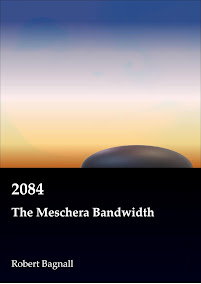


2084 - The Meschera Bandwidth

2084. The world remains at war.

In the Eurasian desert, twenty-year old Adnan emerges from a coma with memories of a strictly ordered city of steel and glass, and a woman he loved.

The city is the Dome, and the woman... is Adnan's secret to keep.

Adnan learns what the Dome is, and what his role really was within it. He learns why everybody fears the Sickness more than the troopers. And he learns why he is the only one who can stop the war.

Persuaded to re-enter the Dome to implant a virus that will bring the war machine to its knees, the resistance think that Adnan is returning to free the many - but really he wants to free the one.

24 0s & a 2

Twenty-four slipstream stories.  Frequently absurd, often minimifidian, occasionally heroic.

“Brilliant stories, well written!” (five stars, Amazon). 

Thursday, 2 April 2026

Sideshow, footnote, irrelevance

Let's be clear. The launch of Artemis II is a sideshow, a footnote, an irrelevance. 

It won't end any wars, or put food on the tables of the starving, or stop young girls in Africa walking miles to get water from wells, time they could have spent in school. If anything, it's diverting funds from those here-and-now (emphasis on the 'here') problems.

So, let's talk about something that really matters.

Beer.

We recently went on an expedition from the country to the Big Smoke, Olde London Towne (pronounced 'Old London Town', obvs), not for the drinking of beer but for non-yeast based culture, but a few beers were had along the way.

But my ale-adjacent experience somehow illustrates how cultures, traditions, ways of life erode and disappear. And fiction that builds futures has to take in not just the shiny and new, but how the tarnished and out-of-fashion gets pushed aside and pushed away.

I'm not quite sure how, but I offer this as a possible case study.

You'd think getting a good pint in London would be guaranteed. London was once home to some of the largest breweries in the world, rolling out hundreds of thousands of barrels of beer a year. Christ, in the Great Beer Flood of 1814, the bursting of a single vat was enough to collapse buildings and kill people. London brewed a lot of beer because London drank a lot of beer. London knew beer.

But not any more, it seems to me.

My first pint was in an otherwise excellent curry house. There seems to be a curry-house curse, mainly relating to sizing and container-style, where a Venn diagram between what's on the menu, what you ask for, and what's served overlap but don't align.

Seeing a large bottle of Cobra on the shelf, I asked for one with a small glass to serve myself, and was given a pint. A short pint.

Oh. Was that from the bottle? 

Yes.

Then where's the rest of the 660ml bottle?

Bafflement.

I still have no idea whether I was served draught or from a can. Certainly not a bottle.

Conclusion: the importance of variation (a can doesn't taste the same as draught, nor does the bottle) and serving (keeping the head topped up and avoiding those stupid bloody tall glasses only good for flowers isn't just a whim) is being lost. As long as the brand is right nothing else matters.

The second pint was just a half before the theatre. The first that was served was flat as a puddle, and, as far as I could tell - because no way on God's green earth was it getting near my lips - had all the other characteristics of a puddle. It took a bit of persuasion to get the point across that beer shouldn't look like that before it got changed. 

Oh, and two halves (of a still middling brew) and a lemonade was £12. You'd think they'd treat it as a premium product.

Conclusion: knowledge of what the product should and should not look like is vanishing. It's brown, it's liquid, it has a sort of scum on top. Isn't that beer?

The third pint was more of the same, except this time, as I was ordering two, I only realised the issue when the second one was being drawn. I did query whether that was what that particular beer and was persuaded, reluctantly, that, no, that's what it's like.

Really?

Ten minutes later, that particular brew was off. I did try to tell them.

My next pint there (yes, we stayed) was a New England IPA on tap rather than handpump. It was lovely but a bit heart-breaking as the handpump beer was looking rather like a ageing horse staring at a shiny new tractor. The world turns. But we've been here before - a century ago you'd have had milds and porters in every pub. Now, outside beer festivals, you'd struggle. You don't often even see winter warmers anymore. Bloody global warming.

There's a bit of everything here. The melting pot of cultures, changing habits, lack of knowledge, lack of giving a shit. Suddenly finding yourself out of step. The world changes. You ride the wave for a bit. Then end up dazed with the taste of seawater in your mouth.

#

Click on the images or search on Amazon.
You're here, so surely you know how?


My Thoughts are with You. Your Thoughts are with the Authorities for Calibration Against Societal Norms

Meet a man mistaken for a robot, a robot which learns the meaning of irony the hard way, a Frankenstein’s monster with a future in tailoring, a talking cat, a talking car, several time travellers, and a host of other characters.

Award-nominated science fiction and slipstream author Robert Bagnall’s second anthology of twenty-four stories, variously bleak, funny, bleakly funny or – very occasionally – optimistic.


2084 - The Meschera Bandwidth

2084. The world remains at war.

In the Eurasian desert, twenty-year old Adnan emerges from a coma with memories of a strictly ordered city of steel and glass, and a woman he loved.

The city is the Dome, and the woman... is Adnan's secret to keep.

Adnan learns what the Dome is, and what his role really was within it. He learns why everybody fears the Sickness more than the troopers. And he learns why he is the only one who can stop the war.

Persuaded to re-enter the Dome to implant a virus that will bring the war machine to its knees, the resistance think that Adnan is returning to free the many - but really he wants to free the one.

24 0s & a 2

Twenty-four slipstream stories.  Frequently absurd, often minimifidian, occasionally heroic.

“Brilliant stories, well written!” (five stars, Amazon).