We were recently on the beautiful, if arid, island of Gozo, where we were scammed out of €5. It would have been €4 if we'd had coins.
We were stopped on a quiet street by a man who claimed to be from Leicester (maybe that bit was true), fresh off the ferry whose car had run out of petrol, and he was having trouble with his phone and cards, and Hertz weren't picking up, and he was €4 in cash short of what he needed to refuel his car. We only had notes and gave him €5. We walked on, suspicious of the story, but also thinking, if it were a con, surely it would be aiming a bit higher, be all a bit slicker. The Sting, this was not.
We know for sure it was a scam, because the same man tried the same line on us a few days later on a different street (you'd think a con-artist would make a point of remembering faces). When reminded, he sidled off, denying we'd ever met before.
Humans are rubbish, aren't they?
Meanwhile, I've received this very nice email from New York Times best-selling author, Mary Alice Monroe relating to my novella The Credo of Comrade January:
Hi Robert,
I hope you're doing well.
I recently finished reading The Credo of Comrade January and wanted to reach out personally. I don’t often email authors out of the blue, but your book stayed with me after I finished it, and I felt it was worth making a connection.
What really stood out to me was the way you grounded a high-concept idea in something deeply human. The premise of a post-digital world shaped by solar “Pulse” events immediately sets a strong tone, but what made the story resonate more was Alexi’s personal journey beneath it all. His discovery that reality itself may be split, and that he might have access to a parallel version of his life, adds both intellectual weight and emotional urgency to the narrative.
I especially appreciated the balance between political tension, scientific curiosity, and personal loss. The idea of an aging mathematician confronting both a controlling regime and the possibility of rewriting his fractured past gives the story a reflective quality that lingers beyond the speculative elements. It feels like a story that is as much about consequence and choice as it is about science fiction concepts.
As someone who spends a great deal of time around books and authors, I always admire stories that combine big ideas with grounded emotional stakes. Your work does that in a way that feels thoughtful and compelling.
I’m not writing to pitch anything. I simply wanted to let you know I enjoyed the book and introduce myself. It would be great to connect with a fellow author whose work blends philosophy, science, and human experience so effectively.
Thank you for sharing Alexi’s story with readers. It was a genuinely engaging read, and I look forward to seeing what you write next.
Except, it's not from Mary Alice Monroe. It's a scam. This is the hook, the bait will follow - presumably, a massive, once-in-a-lifetime opportunity, such as mentorship, an exclusive review, or an introduction to a top publisher/movie producer - and then the switch, when money (just to cover expenses, you know) will be demanded for the privilege. I'm almost intrigued enough to see what happens next. Almost, but not quite, as I've marked it as spam and blocked the address.
What gets me is that it's a very perceptive - humanly perceptive - reading of the book, which I don't think comes from scraping reviews (currently five stars on Amazon; 4.75 on Goodreads). There haven't been enough of them, and they haven't dug as deeply, which makes me think this is predominantly AI-generated. AI's ability to do that, and the speed at which AI has achieved that, is terrifying. It's akin to watching your kids grow up, going from babbling to calculus. It'll be Stephen Hawking-smart by Christmas.
But, maybe, what's more telling is that the human scammer got 25% more than what he asked for out of us by being borderline-rubbish, whilst my Spidey-sense immediately smelt phishing. The email was just too neat, too perfect, too slick. My prediction is AI will prove to be too clever by half, and that will be its downfall. Maybe if the bogus Mary Alice Monroe had simply asked for $4?...
#
Click on the images or search on Amazon.
You're here, so surely you know how?
My Thoughts are with You. Your Thoughts are with the Authorities for Calibration Against Societal Norms
Meet a man mistaken for a robot, a robot which learns the meaning of irony the hard way, a Frankenstein’s monster with a future in tailoring, a talking cat, a talking car, several time travellers, and a host of other characters.
Award-nominated science fiction and slipstream author Robert Bagnall’s second anthology of twenty-four stories, variously bleak, funny, bleakly funny or – very occasionally – optimistic.
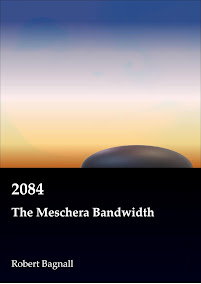

2084 - The Meschera Bandwidth
2084. The world remains at war.
In the Eurasian desert, twenty-year old Adnan emerges from a coma with memories of a strictly ordered city of steel and glass, and a woman he loved.
The city is the Dome, and the woman... is Adnan's secret to keep.
Adnan learns what the Dome is, and what his role really was within it. He learns why everybody fears the Sickness more than the troopers. And he learns why he is the only one who can stop the war.
Persuaded to re-enter the Dome to implant a virus that will bring the war machine to its knees, the resistance think that Adnan is returning to free the many - but really he wants to free the one.
24 0s & a 2
Twenty-four slipstream stories. Frequently absurd, often minimifidian, occasionally heroic.
“Brilliant stories, well written!” (five stars, Amazon).


