Sunday, 24 April 2022

Like side two of the first Tindersticks LP

Writing about recent successful story submissions requires a degree of cognitive dissonance on my part.  On the one hand, it's a tale of manuscripts that have sat on the shelf, dowdy and unloved to the point of having grey hair and half-moon glasses, finally finding their dancing partners.  On the other, of new stories still wet behind the ears flying out of the door before they have a chance to absorb carping feedback and get boiled down in the inevitable rewrites.

As far as the former go, a pair recently sold have racked up ninety-nine rejections between them, before finding success with submissions number one-hundred and one-hundred-and-one.  And another with fifty knockbacks under its belt is, at least as far as the Grinder is concerned, just about the longest standing unrejected submission with three different venues at the same time.

And that last point, of simultaneous submissions, is where I have a slight confession to make.  I've previously blogged about my take on (not) observing publishers' rules about simultaneous submissions, and have now been hoisted ever so slightly by my own petard.

Of course, I blame the fact that I seem to have hit a rich vein of form, like side two* of the Tindersticks' first LP (insert your own metaphor, musical or otherwise), where what I write turns swiftly to sales.  It's temporary, of course.  You can’t bottle lightening, and all that.  Even the Tindersticks couldn't keep it up, although my recollection is that Simple Pleasure was damn good.  But I've had one story sell on its first outing, and another sell twice in its first four showings at market, in the style of Max Bialystok.

In my defence, m'lud, I cite statistics.  I submit each story, maybe ten times a year, and have a success rate of one in thirty, meaning stories normally take three years, on average, to sell.  Only around a third of my stories are with more than one venue at any one time, and most of the time those markets allow simultaneous submissions.  So I reckon the chances of two venues, neither of which accepts simultaneous submissions, both accepting a story within a narrow window of opportunity should happen, on average, every century or so.  But that's on average, and assumes my stories remain average, which I don’t think they are - even if the 10,000 hour rule is bunk, the practice must be showing, right?

So, without saying which are the spinsters and which the debs, all of the following new, original, and previously unpublished stories sold in a dizzying ten-day period:

* of the double vinyl, of course, the tracks from 'City Sickness' to 'Marbles', not the CD, where side two presumably means the printed picture of the flamenco dancer on the face not read by the laser.  Precisely what ‘side two’ may mean to anyone under forty reading this for whom music inevitably means a Spotify download is anyone's guess...

#
Click on the images or search for these on Amazon.
You're here, so surely you know how to do that?


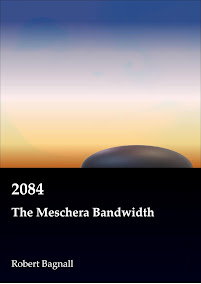
2084 - The Meschera Bandwidth

2084. The world remains at war.

In the Eurasian desert, twenty-year old Adnan emerges from a coma with memories of a strictly ordered city of steel and glass, and a woman he loved.

The city is the Dome, and the woman... is Adnan's secret to keep.

Adnan learns what the Dome is, and what his role really was within it. He learns why everybody fears the Sickness more than the troopers. And he learns why he is the only one who can stop the war.

Persuaded to re-enter the Dome to implant a virus that will bring the war machine to its knees, the resistance think that Adnan is returning to free the many - but really he wants to free the one.

24 0s & a 2

Twenty-four slipstream stories.  Frequently absurd, often minimifidian, occasionally heroic. 

Sunday, 10 April 2022

If it's okay for Billy

I'm a great believer in it being bad karma to talk about stories before they're picked up by a venue.  So it's proved with my rewrite for Solarpunk, which they didn't like enough to take.  Win some, lose some, move on.

So, let me test the writing-gods once more by relating another rewrite request.  This one's for Shoreline of Infinity, for which I have a certain fond regard.  I've exchanged emails with editor Noel Chidwick, who comes across as genuine and approachable. It's British - proudly Scottish - so I get the sense that we're a bit more aligned in our sensibilities compared to some of the more overly-focus grouped and offended-on-behalf-of-others American venues.  I know the editor of The Best British Science Fiction has a lot of love for it.  Plus I see it's recently put its rates up.  Obvs, it's the last one that really counts.

My story having been with them since last June, this was the feedback I got:

Very well written and observed - it cracks along at a fair pace. At first I was thrown by the genre-mix: cop/crime-alternate reality/fantasy... But by the end, I think it worked. I was convinced. However, the problem I have is that it's a first person story in which the narrator appears to be heading towards her death. So how did she relate the tale? And if she survived, how? If the story could be rewritten in the third person, I think it'd work far better.

Now, I'll say straight up, that I've never had the slightest problem with the idea of a first person narrator - the 'I' of the story - dying.  If it was okay for Billy Wilder, it's okay for me.  And I'm aware that we're not alone, Billy and me.  In fact, I've struggled to see what the objections could be, and this from somebody who would rather be torn apart by wild animals than do up the bottom button of a waistcoat.

The Moonlighting Writer suggests those reasons may be because:

  • you annoy your audience (answer: I write to unsettle);
  • it's jarring (answer: this particular ending is the cliff-hanger where the narrator may or may not die, so I'd say it's a natural ending); or,
  • it robs you of the possibility of a sequel (answer: it's a short story, and I don't think I've ever written the same character twice)
My understanding is that Sunset Boulevard got a fair amount of stick at the time for the device, although it doesn't seem to be coming to the surface of my Google searches.  Perhaps I read it in Cameron Crowe's excellent Conversations with Wilder, which I no longer have, or perhaps I've misremembered?  If true, I suspect it was more the shock of the new than a fundamental feeling of being cheated.  If anything, Sunset Boulevard merely kicked the door open for hoards to follow - just look at the examples on that TV Tropes link. 

Thinking it through, I can only conclude that for you, dear reader, these characters we paint through black pixels on white, or inky scribbles on paper, are real.  They're not the constructs they are for the writer, who builds them from some skeletal armature, chooses their clothes and voice and gait and preferences and tics.  It's a game for us, but, hey, you buy into it.  You really buy into it.  Perhaps that's the fundamental difference between writer and reader.  You don't see behind the curtain.  Maybe you don't even want to see behind the curtain...

Of course, when it came to the rewrite itself, principles disappeared.  I may have just painted the writer as god, but compared to editors...

#

And, just to try to balance the karma out a bit, some news on a story that has been taken: Medusa Tales, who publish 'stories of transformation', will be running Devil Ray at the Doorway, my tale of a bad mermaid in a tsunami.

#

Click on the images or search for these on Amazon.
You're here, so surely you know how to do that?


2084 - The Meschera Bandwidth

2084. The world remains at war.

In the Eurasian desert, twenty-year old Adnan emerges from a coma with memories of a strictly ordered city of steel and glass, and a woman he loved.

The city is the Dome, and the woman... is Adnan's secret to keep.

Adnan learns what the Dome is, and what his role really was within it. He learns why everybody fears the Sickness more than the troopers. And he learns why he is the only one who can stop the war.

Persuaded to re-enter the Dome to implant a virus that will bring the war machine to its knees, the resistance think that Adnan is returning to free the many - but really he wants to free the one.

24 0s & a 2

Twenty-four slipstream stories.  Frequently absurd, often minimifidian, occasionally heroic.

Wednesday, 23 March 2022

Okja - bacon sarnies, anyone?

I finally caught up with Bong Joon Ho's 2017 Okja, a film superior IMHO to the over-lauded Parasite.  There.  Nothing like getting the controversy in early.

As you can probably tell from that gambit, there's a lot I liked about the movie - from Jake Gyllenhaal's bonkers (and virtually unrecognisable) TV naturalist to the loveable (but not loveable enough to put me off bacon) Okja.  And credit to the effects people for remembering that post-violence physiology is as much about swelling as bleeding. 

There was, however, one element that grated.  It's how the film portrays our view of genetically modified organisms (GMO).  The story relies on Tilda Swinton's Lucy Mirando, CEO of the Monsanto-in-disguise corporate villains, hiding Okja's genetically modified roots under a smokescreen of a bucolic miracle, mother nature handing us this uber-porker through her munificence and benevolence.  It plays to - and worse, reinforces - all the misunderstanding about GMOs.

What is it about humanity's sudden mistrust of genetically modified plants and animals?  We've been genetically modifying them for millennia, just by guesswork.  It's called cross-breeding: putting the tastiest animal in with the biggest and picking out the ones that have both traits from the litter, or grafting a heavy-cropping stem on to a hardy rootstock.

Genetically modifying flora and fauna in the modern sense is no different, it's just doing it with the lights on and the boxing gloves off.  We can see the mechanism under the bonnet, pick out the gene combinations for colour, flavour, yield and disease resistance.  We no longer have to guess.

How we use GMOs may be problematic, of course.  Making a grain resistant to pesticides allows you Agent Orange the farm at the expense of every living thing other than your cash crop.  For clarity, I think that is a BAD THING.  But it doesn't make GMOs a bad thing.  It does, however, mean that GMOs open up a whole new world of bad things.  It's like saying that the invention of the internal combustion engine was a huge evil because it allowed the development of tanks and warplanes, forgetting that it also gets food into our shops and people to hospitals.

But a cursory search of the internet shows that many, many people have swallowed the whole Frankenfood scare story, more so amongst the young which, to me, demonstrates that the power of the social media echo chamber outguns the classroom's ability to teach people to think rationally.  GM foods cause cancer?  Well, let me name a couple of really quite natural consumables that do that just as well - tobacco and alcohol.  QED: being GMO or non-GMO has nothing to do with it.

Given this, and the resistance we've seen to Covid-19 vaccines, I wonder whether it's possible to produce something akin to Asimov's three laws of robotics, but for humanity's stance towards innovation?  How about:

  • If I can see how it works, I'll trust it (e.g. the wheel)
  • If I can't see how it works, but it brings me entertainment or pleasure, I'll trust it (e.g. the Internet, street drugs)
  • If I can't see how it works, but it predates me, I'll trust it (e.g. fire)
  • Everything else is witchcraft
As a species, we're fucked, aren't we?

#

Click on the images or search for these on Amazon.
You're here, so surely you know how to do that?


2084 - The Meschera Bandwidth

2084. The world remains at war.

In the Eurasian desert, twenty-year old Adnan emerges from a coma with memories of a strictly ordered city of steel and glass, and a woman he loved.

The city is the Dome, and the woman... is Adnan's secret to keep.

Adnan learns what the Dome is, and what his role really was within it. He learns why everybody fears the Sickness more than the troopers. And he learns why he is the only one who can stop the war.

Persuaded to re-enter the Dome to implant a virus that will bring the war machine to its knees, the resistance think that Adnan is returning to free the many - but really he wants to free the one.

24 0s & a 2

Twenty-four slipstream stories.  Frequently absurd, often minimifidian, occasionally heroic.

Monday, 14 March 2022

Perhaps I'm part of the problem?

I sit before you splenetic and confused.

At the weekend I attempted a palace coup, as one does on a sunny Saturday in early Spring, to wrest control from those asleep at the wheel of the local branch of a national environmental body I recently joined (reading previous blog postings will provide dots for you to join).  For a little less than twenty-four hours, I was co-chair and co-treasurer, before the out-going chair decided that a constitutional rule requiring attendance at six prior meetings in order to be nominated for a committee role still held, hence my nomination, and therefore appointment, was invalid.

Given a) the meeting was to revive a moribund group and form a new committee, with few long-standing members having the continuing energy to push things forward, b) this was only the group's second meeting since 2019, and c) there were only eight of us in the room, two of whom wished to be shot of their responsibilities, with few others enthusiastic, and we needed four committee members, draw your own conclusions.  You may cite a focus on following procedure over achieving results: RMS Titanic, deckchairs, etc.  Mine is that they'd rather have the climate rise by two Celsius than me in a position of influence.

Why that may be so is, I think, illustrated by a drabble that I submitted to Solarpunk magazine.  Now, Solarpunk declares itself to be 'a publication of radically hopeful and optimistic science fiction and fantasy'.  My drabble concerned a bioengineer who solved the climate crisis, leaving her empty and depressed.  So, she lit the fuse of an even bigger problem, giving her life renewed focus, even if it left the rest of us like boiling frogs in a cauldron.

I sent it to them as much as a joke as anything; it fitted their brief, if not their ethos.  I sent it to them mainly because I enjoy being awkward and contrary (see above), but also to prick the smug 'it'll all be all right in the end' bubble that I see regularly.  Because, and this is what's driving this posting's title, I do wonder whether we, science fiction writers, do not carry an iota of responsibility by being a little too good at our game.

Yes, let me repeat, perhaps some of us, not all of us, are just a little too prescient.

I'm looking at you Mark Twain, inventor of the internet.  And you, Douglas Adams, father of ebooks.  Stand up, Hugo Gernsback, and admit you gave us Facetime.

Science fiction is littered with examples of predictions that actually came true.  And I think this may have fooled us into thinking that if we all hang around long enough, there'll be some magical technological solution along in a moment.  That Apple will save the apple, along with all the other flora, plus the fauna, including us.  Just look how we invented a vaccine whilst living through a live, interactive, global performance of Soderbergh's Contagion.

Just because we can write the solutions, and get really, really lucky every so often, doesn't mean we have, or ever will have, the solutions.  For every self-driving car (ta, Ray), there's faster than light travel or time travel.  Even those who don't make this basic category mistake are, I think, lulled into a false sense of security.  I know it isn't true, but I bet I'll be responsible for more carbon going into the atmosphere than coming out today, and I should be panicking more about it than I am.

Now, you may have expected Solarpunk to have batted my piece straight back to me.  But no, they liked the writing, and asked me to expand it and align it to their philosophy.  Make it positive.  Make it hopeful and optimistic.

At first, I guffawed - they'd misunderstood, hadn't got the joke, the snowflakes.  Rewriting as requested would negate the whole point of the piece.  Then I thought about it, tossed it over in my mind, saw it from the other side.  And now my drabble has doubled in length - still a quarter the length of this post - but guess what: Alex the bioengineer has solved the second problem she set herself, and has made the world an even better place.  I'm going to send it off to them today.

If it ever sees the light of day, I'd like to be clear that it's utter hokum, but optimistic, positive hokum.  Don't be fooled into thinking any of my hand-waving science signals a possible solution to the environmental crisis within.  But I rather like it.  We need more of it as the water levels rise and the trees catch fire.  Help take our minds off things.

#

Click on the images or search for these on Amazon.
You're here, so surely you know how to do that?


2084 - The Meschera Bandwidth

2084. The world remains at war.

In the Eurasian desert, twenty-year old Adnan emerges from a coma with memories of a strictly ordered city of steel and glass, and a woman he loved.

The city is the Dome, and the woman... is Adnan's secret to keep.

Adnan learns what the Dome is, and what his role really was within it. He learns why everybody fears the Sickness more than the troopers. And he learns why he is the only one who can stop the war.

Persuaded to re-enter the Dome to implant a virus that will bring the war machine to its knees, the resistance think that Adnan is returning to free the many - but really he wants to free the one.

24 0s & a 2

Twenty-four slipstream stories.  Frequently absurd, often minimifidian, occasionally heroic.


Tuesday, 22 February 2022

See target, hit target

Regular readers who aren't Russian bots trying to break into my bank account (why don't you go and invade a country or something... oh, you are) may know that I have a target of selling three stories a year or I pack it in, concentrate on draught beer in a can (cognitive dissonance in a can, more like) and daytime TV.

Well, that target was hit in twenty-nine days this year, and if you want to restrict it to three new stories, then I can report that took just thirty-nine revolutions of our little blue marble.  Here's where you'll be able to find new words from me sometime soon:

  • …And You Will Know Us by the Trail of Dead. That, and T-Shirt Sales, a Pratchett-like satire on rock music and The Four Horsemen and rewrite of a radio sitcom pilot I wrote whilst at university, sent off to the BBC, then forgot about, will appear in Mystery and Horror's 'Strangely Funny IX'.  I'm particularly glad it's out the door as it has Covid-references which are already pushing past their 'best before' date...
  • The Digital Mortician, which first appeared in Big Pulp in 2013 will be available again through JayHenge's 'Phantom Thieves & Sagacious Scoundrels'.  I keep sending them stuff and they keep accepting 'em.  Which is nice.
  • Working Late, a previously unpublished drabble, has gone to Black Ink Fiction's 'Legends of the Night' strand.  I know what you're thinking: it's a drabble! Hey, from where I'm sitting, it's a sale.
  • A story that I still think of as The Watcher will be published as Minerva Revealed in Off Topic Publishing's 'Wayward and Upward'.  The change of title comes from the anthology being themed around pre-written music, with the stories and poems all sharing titles with the tracks.  I don't quite know how I feel when stories I've lived with for a while are published under only recently-adopted aliases.  A bit like when you see your children in clothes they've chosen for themselves for the first time, I think.
  • Another reprint and another satire, Dangerous Paranoia - the Choice of a New Generation, first published in 2011, will be out again courtesy of Story Unlikely, a slightly weird set-up to the extent that the Grinder credits their existence but refuses to countenance them, as submission is taken as a one-sided agreement for them to publish if they want.  Hence they'll only be sent reprints by me, but it'll be good to see this one stretching its legs again for the first time in over a decade.
I had hoped to add Galaxy's Edge, the highly regarded periodical started by Mike Resnick, as opposed to the Disneyland ride but the rewrite notes promised 'within forty-eight hours' last month have yet to appear...  Wormhole in time and space, anyone?

#

Click on the images or search for these on Amazon.
You're here, so surely you know how to do that?


2084 - The Meschera Bandwidth

2084. The world remains at war.

In the Eurasian desert, twenty-year old Adnan emerges from a coma with memories of a strictly ordered city of steel and glass, and a woman he loved.

The city is the Dome, and the woman... is Adnan's secret to keep.

Adnan learns what the Dome is, and what his role really was within it. He learns why everybody fears the Sickness more than the troopers. And he learns why he is the only one who can stop the war.

Persuaded to re-enter the Dome to implant a virus that will bring the war machine to its knees, the resistance think that Adnan is returning to free the many - but really he wants to free the one.

24 0s & a 2

Twenty-four slipstream stories.  Frequently absurd, often minimifidian, occasionally heroic.

Saturday, 12 February 2022

If the chemist's was on Kepler-22b

“Space is big. You just won't believe how vastly, hugely, mind-bogglingly big it is. I mean, you may think it's a long way down the road to the chemist's, but that's just peanuts to space.”

As put by Douglas Adams, and so ably illustrated here, by Neal Agarwal.

#

Click on the images or search for these on Amazon.
You're here, so surely you know how to do that?


2084 - The Meschera Bandwidth

2084. The world remains at war.

In the Eurasian desert, twenty-year old Adnan emerges from a coma with memories of a strictly ordered city of steel and glass, and a woman he loved.

The city is the Dome, and the woman... is Adnan's secret to keep.

Adnan learns what the Dome is, and what his role really was within it. He learns why everybody fears the Sickness more than the troopers. And he learns why he is the only one who can stop the war.

Persuaded to re-enter the Dome to implant a virus that will bring the war machine to its knees, the resistance think that Adnan is returning to free the many - but really he wants to free the one.

24 0s & a 2

Twenty-four slipstream stories.  Frequently absurd, often minimifidian, occasionally heroic.

Saturday, 22 January 2022

'Ready Player One' by Ernest Cline

Contains spoilers

I always wondered what happened to Peter Pan.  Turned out he was busy writing 'Ready Player One'.

Having just finished it, I'm left with mixed feelings.  One the one hand, it's a page-turning ride.  With the final lines of each chapter, I wanted to know what happened next.  Isn't that praise enough for what's just meant to be a bit of escapist genre fiction?  Cline's not pretending to be writing The Brothers Karamazov.

So, what irks?

There's a formula going on here, so front and centre that I can feel myself being played.  I feel exploited; ever so slightly dirty.  And I can't think of a better way of putting what feels off about it than quoting Ursula Le Guin on Tolkien, that the "peculiar rhythm of the book, its continual alteration of distress and relief, threat and reassurance, tension and relaxation: this rocking-horse gait (which is precisely what makes the huge book readable to a child of nine or ten) may well not suit a jet-age adult."

And the thing about formulae is that they are so… well, formulaic.  If you play ‘guess what’s next’ you’re not going to need that many lives.  That the hero wins in the end and the pantomime baddie gets their comeuppance?  Check.  That victory is snatched from the jaws of defeat again and again?  Check.  That the macho avatar hides a geeky lesbian?  Not so much check as pre-checked by the focus group of wokeness.

And I guess that’s part of my gripe.  If we were living in some Orwellian society (whaddyamean ‘if’?), this is exactly the kind of brain tranquilliser they’d be feeding me keep me politically onside.  I don’t feel I’m getting Ernest Cline so much as Ernest Cline’s view of what it is he thinks I think I want to hear.  I want Ernie to stretch my envelope, not pander to me.

Part of the what leaves me uneasy is the amount of time the book spends in its game playing metaverse.  Not that it’s a problem in itself, but the lack of impact of the real world on this false reality feels phoney in itself. There’s a sort of importance given to things in inverse proportion to what's really important.  People die in the real world but I get a sense that the right motions are autistically gone through, but that's all they are - motions.  Even more basically, does Parzival ever stop to piss?  I wanted this to turn out to be a game within a game, for Wade Watts to be an avatar of an off-page protagonist and everyone else in the story to be constructs of the game.  Only then could I buy Parzival’s continual will-he-won’t-he-fuck-me-he-has progress.  I wanted that ending because there’s a level of escapism that’s just too much - think Alice versus heroin.  Anything else stretches credulity.

But perhaps this just reflects that I am not the target audience.  I’m not a teenager. I own a couple, standard issue models.  And any other owner will know the drill.  The coffee mugs that cease to be visible once they've been emptied, hence never need to be returned to the kitchen.  The way world peace is easy but self organisation isn't.  The floordrobe.  For them the real world is a distraction from their screenlife, no matter how much you try yelling at them.  Explain, and they just look at you like lions in the zoo look at you, dead-eyed, just waiting for you to stop talking. That’s behind my j’accuse up top.  Peter Pan never grew up - and this feels like it’s written by a perpetual adolescent.

Of course, Spielberg went and turned this into a movie.  But, remember, Speilberg's the guy that greenlit the ET game, regarded as the worst game ever released.  Just saying.

#

Click on the images or search for these on Amazon.
You're here, so surely you know how to do that?


2084 - The Meschera Bandwidth

2084. The world remains at war.

In the Eurasian desert, twenty-year old Adnan emerges from a coma with memories of a strictly ordered city of steel and glass, and a woman he loved.

The city is the Dome, and the woman... is Adnan's secret to keep.

Adnan learns what the Dome is, and what his role really was within it. He learns why everybody fears the Sickness more than the troopers. And he learns why he is the only one who can stop the war.

Persuaded to re-enter the Dome to implant a virus that will bring the war machine to its knees, the resistance think that Adnan is returning to free the many - but really he wants to free the one.

24 0s & a 2

Twenty-four slipstream stories.  Frequently absurd, often minimifidian, occasionally heroic.