Tuesday, 23 February 2021

It's Chinatown, Mike

I used to write screenplays.

No, don't look for me on IMDB, because I'm not there.  I wrote six, sold four; two on spec to, and two on commission for British indie production companies that were little more than a couple of blokes and a business card looking for other people's cash.  Merge the three companies I worked with (the two commissions were for the same people), and I think you could fit all involved into a mid-sized people carrier.  That said, I found out years later that Ric Young ("Too much to drink, Doctor Jones?") was the Los Angeles end of the one operation that didn't seem to be completely built on sand.

My only other sighting of fame and fortune in the distance, heading away from me, out of reach, was a pitch meeting with a freelance development executive with ties to DNA and Working Title.  I knew that because we sat in a lobby with two doors leading off, one marked 'DNA', the other 'Working Title'.  After I had pitched something along the lines of The Thing set in Afghanistan, we talked about what else we did with our lives.  I tried to make human resources sound exciting; he told me he managed Keane.  'Nuff said.

The reason I bring this up is only partially through mystification as to where it all went wrong.  There is a school of thought that Robert Towne's script for Chinatown is the apogee of the screenwriter's craft, the perfect screenplay.  I'm not here to agree or disagree, but to give a slightly different take.

Which is this: if Chinatown had never been made, and an unknown writer were to turn in exactly those words, would it be recognised as such?  Would a producer say that any change would be a move slightly down the slope of quality?  Would it be declared fit for purpose, fit for production, without so much as a note?

I don't think so.  The idea that a first draft could be the best draft, that the writer has found his or her way around all the problems in the most effective and efficient way is an anathema.  There are always changes to be made, and its how the creative process demonstrates its worth.  By people sticking their oar in and putting their stamp on things.

So, with that logic, couldn't Chinatown have been tweaked some more?  Well, yes, it could, but the point is that it had been tweaked enough.  Every draft contains arbitrary choices, which are neither better nor worse than other arbitrary choices.  What gets made or printed is where you were when the music stopped.  And, if you're an unknown, you're going to get tweaked, even if those amendments blur the vision, muddle the narrative, or skew the arc.

The opposite end of this problem was brought home to me by 'The Homecoming' by Mike Resnick in Galaxy's Edge 48.  Whilst this is still the latest issue, you can read it for free.  If you're stumbling over this blog in months and years to come, I guess that link will take you elsewhere.

Now, I have a lot of time for Mike Resnick's work, and I'm well aware that he is both no longer here to respond, and that he put a lot back whilst he was.  To the best of my knowledge, he was one of the good guys.  I've read stories by him that have stood out as exemplars.  But I have an issue with this particular story, which is fine, but... God, it could be cut by 50%, or more.  It's padded like Mister Creosote on a Chesterfield.  There's a good little story trying to get out, but it's a flash at best.  Oh, for an editor with a good blue pencil.

You'll recall that I have a story hovering on the edge of one particular SFWA-recognised publication.  Its fate is still undecided, 'under consideration'.  It's been subjected to three sets of notes and is far better for it.  In each and every rewrite they've asked me to tighten and tighten, much as a football coach asks his team to up the tempo, regardless of whether he has anything else tactical to offer.  And, like a tired footballer, I've wondered how the hell to manage it, and then found what's required.

And yet, I read stories like 'The Homecoming' with their languid pacing and verbal redundancies and can't help thinking how those editors telling me to 'make it run faster' would react; that, just as an unknown's Chinatown would get copious notes, so the works of the big beasts are far more liable to be ticked through with a minimum of a proof and a polish, regardless of their objective quality.  If I had put my name on this and sent it out, I'm not confident I'd get any takers in its current form, not even from the semi-professional market.  I know many won't like me saying that, but I can't help thinking it.

There seems to be only one solution to this conundrum.  I must continue to battle to get myself on to a higher level, where I'll be better able to get stories into print without so much critical scrutiny.  And you, dear reader, should focus your attention on reading the works of relative unknowns, who have had to go through the mill to prove their worth.  So, in that spirit, could I recommend these two worthy works? 

#
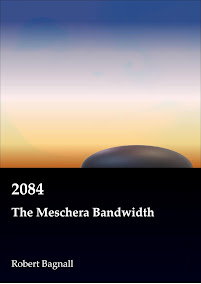
Click on the images or search for these on Amazon.
You're here, so surely you know how to do that?


2084 - The Meschera Bandwidth

2084. The world remains at war.

In the Eurasian desert, twenty-year old Adnan emerges from a coma with memories of a strictly ordered city of steel and glass, and a woman he loved.

The city is the Dome, and the woman... is Adnan's secret to keep.

Adnan learns what the Dome is, and what his role really was within it. He learns why everybody fears the Sickness more than the troopers. And he learns why he is the only one who can stop the war.

Persuaded to re-enter the Dome to implant a virus that will bring the war machine to its knees, the resistance think that Adnan is returning to free the many - but really he wants to free the one.

24 0s & a 2

Twenty-four slipstream stories.  Frequently absurd, often minimifidian, occasionally heroic.


Monday, 1 February 2021

Most heinous

Here are a couple of offensive images from a movie that may be naggingly, tip-of-the-tongue familiar to many.  But which is the most egregious?


Yes, it's the top one, of Carrie Fisher as Princess Leia, being objectified for the ogling delectation of men.  That's what society decrees, and we have to fall into step with the groupthink that cannot be anything other than right and proper. Wash my brain out with napalm jelly if I were to think anything else.

Well, I fear you may have to prepare some jelly (with cream or ice cream, really don't mind) because I can't help disagreeing. 

And it's not because Fisher's get-up is consistent with the story, and what Jabba's character would do with her, displaying her as a hands-off-she's-mine trophy, although that's all true. The instant riposte to that is that it's not as though this is documentary (sorry, die-hard Star Wars fans); the film-makers have as much control over what story they chose to tell as well as how to tell it.

No, the reason I find the second more offensive than the first (I'm not even sure I do find it offensive, but I recognise that others do and, more importantly, the actress found it uncomfortable) is that the first is a value judgment whereas the second is an objective error.  Large animals running wild in a vast desert with nothing to eat or drink?  With no other links in a food chain, not a blade of grass or a mouse?  It's simply not plausible.  (I have similar issues with The Empire Strikes Back's wampa and exogorth, by the way, but at least they have a point in the story).

Speculative fiction is about consequences - if we were to seed the clouds with sea salt to cool the planet, or refreeze the Arctic, would those be isolated effects or would the ripples have unintended consequences?  I'm not pretending this kind of hard sci-fi is a strength of mine - and I'm hugely admiring of those than can pull the trick off, keeping a plausible handle on exactly how the ripples cause their own ripples - but I like to think that I don't populate my fiction with such utter clangers just because they look nice.

Having waded through various treatises on ethics from Aristotle's Nichomachean Ethics onwards during a degree and a half in philosophy, I've always been fascinated how some ethical rules seem to be objective constants set in stone whilst others reflecting the fashion. Taking - of life, of property - seems to be objectively wrong. Sexual ethics, however, tend to reflect the times. Right now, right here, same sex relationships are acceptable whereas relationships involving females only just past puberty are not. Chose another place and/or another time and those rules reverse. Unlike the ones over murder or theft. Odd. Like they're of distinctly different categories.

A lot depends on whether you think we're progressing towards an ideal state or just meandering through future history with no particular place to go. I favour the latter. Right now, we're going through a puritan phase.  In a hundred years time, who's to say that things won't come full circle and we'll all be signing up to the schools of Islamic jurisprudence's historic view that nine years of age is good enough for girls , looking back on today's sense of right and wrong with bafflement. Indeed, some Americans seem to be trying to get back to this 'golden age' already.

One of the drags on human progression is, of course, human nature itself. We can either pretend that it's suitable to take home to meet your parents when it's not, or recognise it for what it is, warts and all. The internet is a very good litmus test. It's basically a porn delivery system that can also aggregate your debts and investments and either make your mailman redundant or give him musculoskeletal issues carrying packages, all depending. It reflects a basic truth about our fundamental nature, however distasteful it may be to some - we are sexual beings with sexual needs, despite society's best efforts.

Whenever I hear arguments otherwise, I'm transported back to a documentary I saw twenty, possibly more, years ago following middle-aged female pornographers. I can't quite remember what their game was - peep shows, telephone chat lines, pole dancing - but they were asked, Aren't you exploiting young women. They fell about laughing. No, they answered, we're exploiting middle-aged men with credit cards.

They were being realistic. There are a lot of people being idealistic, or naive, if you prefer. There always was, always will be people like that, but I fear this contagion is spreading, as evidenced in my recognition that society expects me to openly and loudly react to one of those pictures in a way that is orthogonal with human nature.  There's a zealous, puritanical streak to this that I find concerning, and I fear we're in danger of losing sight of what is important.

This is why we've ended up in a world where the makers of Pixar's Soul made considerable investment ensuring that the film’s cultural reference points struck just the right note but left the story a confusing mess of bum notes, not necessarily played in the right order. Or, as another example, there's now a move to expunge Donald Trump from Home Alone 2, possibly even replacing him with an adult Macaulay Culkin.  It's not that I'm a Trump supporter - anything but - but this rewriting of history puts me in mind of Stalinist purges.

It also affects people who misstep even accidentally. Take a look at this post from respected (and pro-paying) magazine Fireside. I don't know Pablo Defendini, never had anything to do with him, but he strikes me as being as much a victim, of a hysterical over-reaction in his case, as anyone in this. I hope he's found a safe harbour after this farrago.

Let's take a moment to unpack the precedents set.  Pablo was lax in letting through an inappropriate recording. He has made no effort to defend it. He completely sees it for what it is. But somehow it is on a par with producing and broadcasting it with malice aforethought.

That's not how the world works.  That's why manslaughter is a couple of rungs below murder.  That's why intention is really quite a big issue in legal cases.  And, if you are guilty of what the broadcast accidentally did, to what degree are you guilty of all the other things the broadcast could have done but didn'tIf you weren't checking it for racism, you can't have been checking it for every other ism.  Who's to say that it wasn't treacherous, treasonous or inciting a riot?  Why be satisfied with limiting Pablo's statement to matters of race when his modern-day pillorying could cover so many more thought-crimes.

Donning my other professional hat, the one with 'Kiss me Quick' taped over and replaced by the words 'Human Resources', I'm struggling to see how in Britain this dismissal could be legitimate or appropriate, but concede there are legalities about who is ultimately responsible for what is broadcast. Even if it were, such public acts of shaming slam us straight back into a medieval sensibility, and that's what I find most terrifying.

Yes. I'm striding into tricky territory here, and some would say that I'm the last person who should be embarking on this journey - male, stale and pale as I am. But, as the saying goes, zeal without prudence is frenzy. Just a thought.

#

Search for these on Amazon
You're here, so surely you know how to do that?


2084. The world remains at war.

In the Eurasian desert, twenty-year old Adnan emerges from a coma with memories of a strictly ordered city of steel and glass, and a woman he loved.

The city is the Dome, and the woman... is Adnan's secret to keep.

Adnan learns what the Dome is, and what his role really was within it. He learns why everybody fears the Sickness more than the troopers. And he learns why he is the only one who can stop the war.

Persuaded to re-enter the Dome to implant a virus that will bring the war machine to its knees, the resistance think that Adnan is returning to free the many - but really he wants to free the one.

24 0s & a 2

Twenty-four slipstream stories.  Frequently absurd, often minimifidian, occasionally heroic.

Tuesday, 19 January 2021

Dates for your diary, bookmarks for your browser

Some questions:

Well, you could wait until I put together a sequel to 24 0s & a 2, or you could click on the links to read, subscribe, support or pre-order right now. I know what I'd suggest...

#

Search for these on Amazon
You're here, so surely you know how to do that?


2084. The world remains at war.

In the Eurasian desert, twenty-year old Adnan emerges from a coma with memories of a strictly ordered city of steel and glass, and a woman he loved.

The city is the Dome, and the woman... is Adnan's secret to keep.

Adnan learns what the Dome is, and what his role really was within it. He learns why everybody fears the Sickness more than the troopers. And he learns why he is the only one who can stop the war.

Persuaded to re-enter the Dome to implant a virus that will bring the war machine to its knees, the resistance think that Adnan is returning to free the many - but really he wants to free the one.

24 0s & a 2

Twenty-four slipstream stories.  Frequently absurd, often minimifidian, occasionally heroic.


Friday, 1 January 2021

End of term report

Another year chalked off in our long run-up to the heat death of the universe making every achievement of humanity meaningless.  Yes, Happy New Year to you too.

One of the more meaningless acts in the Dada farce we call life is, of course, the creation of fiction.  A grown man, making up stories?  Have you not seen the TV schedules, walked into a bookshop?  There are more stories than any one person can absorb in a lifetime.  And you want to create more?

Yes.  Sorry.  I know it doesn't make sense.  But, occasionally, someone wants to buy them.

Regular readers will know my target is to sell three pieces, and to help that along in the year just departed I aimed to send out at least a piece a day.  When I last set myself that objective the need to commute once a fortnight 400+ miles to London stymied the plan.  Well, Covid made the need to continue up and down Britain's motorway system disappear, along with most of life's liberties, in the spring.  Hence, not surprisingly, I managed 439 submissions (I may have gone a little scattershot nuts), with 283 flat 'no's' and 57 personal thoughts from editors, plus:

  • Audit's Abacus, sold to Daily Science Fiction in January, appearing in May.  This generated far more fan (e)mail than anything I've written previously and also another first - being approached by a venue for rights to podcast the story.  For non-writers the difference may be subtle, but for a semi-pro writer having somebody come to them rather than constantly hawking your wares around the seedier parts of the internet is something of a red letter day.
  • The Hypnotist sold to Hybrid Fiction in January, and appeared in their issue 2 in April.  A 4,500-word sci-fi crime hybrid, it's one of my older stories that's been rewritten endlessly, hence I'm delighted that it's found a home.
  • The Thirteenth Floor ended up appearing in Third Flatiron's Gotta Wear Eclipse Glasses anthology.  A curious one this, as I wanted to submit to their collection of positive, uplifting sci-fi tales but, well, positive and uplifting isn't my writing style.  So I just reversed one of my downbeat endings and tried to make it as internally plausible as possible.  Even so, for one reviewer, the idea of morally good merchant bankers stretched sci-fi's credibility a tad too far...
  • The Loimaa Protocol, a sale last year, made this year's Best of British Science Fiction.  I'm genuinely proud of appearing in three of the last four - and several of those on this list are already with (if she's reading this) the wonderful, wonderful Donna Bond for consideration for next year's collection.
  • The Button at the Base of His Spine, another reprint, was podcast on The Overcast after being picked up in June.
  • Driverless, a tale of a sexually deviant and slight deranged driverless car, was picked up by Black Beacon Books in August and is scheduled for publication next year.
  • Three Wishes, a flash tale of a day out with children gone strange, was accepted by Daily Science Fiction in early September and... well, I'm not sure.  You see, I realised after a couple of months that I may not have responded to the contract offer and sent a sorry-sorry-sorry-yes-please email   I've now been emailing - at a polite, non-hysterical frequency - for a couple of months now, and have not had a single response.  But, I've also submitted and been rejected by DSF twice in that time.  All very odd, and will continue to be odd until I get a quick email back saying all's well - or not...
  • Felis Sarcasticus, previously blogged about, sold in October to Wyldblood and appeared a month later.
  • The Moth, the first of three December sales, will appear in Wasatch Witches, an anthology from the Utah Chapter of the Horror Writers Association, with which I have precious little connection but wish them well.
  • Snowball, a tale of cryptozoological mischief-making, will help launch Land Beyond the World sometime in 2021.
  • Faivish the Imbecile, a tale of Frankenstein's monsters and 1970's Jewish New York tailors, was snapped up by the Quiet Reader between Christmas and the New Year, and will be on their site within days.
  • ...and it's worth mentioning that May Nothing but Happiness Come Through Your Door, Camponotus VampiricusTesla ♥ Waymo 4Ever, and The Artist and the Magician, sold in previous years, were all published in 2020.

Eleven pieces sold, only two reprints, 21,000 words of new material, and around half of those pieces going for decent semi-pro 6c a word or thereabouts rates.  Given that I identified the need to sell longer pieces to better paying venues - I may have sold 17 pieces in the previous years, but 12 were either sub-1000 words, for token payment, or to flaky venues that never published - I think 2020 represents a decent stride forward.  Perhaps my target for this year should be to stop submitting to the penny merchants, at least until I've exhausted all other possibilities for any given story.

Elsewhere, there's the continual sound of pieces bouncing off the transom.  Two silver honorables and two unplaced was my tally at the Writer of the Future contest (idenitical to last year, oddly).  For a long while, the Grinder showed my submission at Fantasy as being the oldest pending piece, before it was dismissed with a whimper rather than a bang.  Analog, Daily Science Fiction, and the Magazine of Fantasy and Science Fiction all had nice things to say about my stories, but not that they were running them.  One got through the outer defences of Pseudopod but couldn't make it count with the editor.  Last rounds and near misses were to be had at Flash Fiction Online, Paper Butterfly and NewMyths.com; a semi final place at the Cast of Wonders Flash Fiction competition.  Of another tale, Curiouser said it was "a really strong piece... a well-paced and fascinating tale... and damn I loved the ending."  Yep, that was a rejection, folks.

But, as ever, irons remain in fires.  Cosmic Roots and Eldritch Shores have bounced back a story three times now with notes, with an invitation for a fourth and last attempt.  I have easily the oldest yet-to-be-rejected submission at Electric Lit, albeit a venue the Grinder shows as never having accepted anything (?!).  Sexy Fantastic Magazine asked for a full ms on the strength of a sample.  Of the 57 outstanding submissions shown on the Grinder, fourteen are amber and seven red.  Some of the blancmange is bound to stick.

Meanwhile, I think I know what you're thinking.  When will this end?  No, I mean, tell us about the novels.

I think it's telling that the report on short fiction sits front and centre.  I had something of an epiphany when I broke off from Toefoot, my dark sci-fi thriller, to work on a 10,000-word Writers of the Future entry, then broke off from that to work on a 1000-word competition flash entry.  I've never considered myself flighty, I'm happy to run marathons (or was), take on major projects, think at scale.  I've already got a novel under my belt, so I know I have the legs to write another, so why can't I stick at it?

Too many ideas, I think.  Too many ideas that work as short fiction, which can be turned out in a week or three.  Too many sci-fi sketches rather than epic sweeps.

But an experience from July didn't help, when I lost the publisher of 2084, Double Dragon, when they folded, Covid being the last straw for what was essentially a one-man band.  My first and final royalty payment?  $2.13.  That's about 0.0025 cents per word.  Not even a coffee.  Puts it all in context, doesn’t it?

The imprint was bought out by Fiction4all, which seemed to be dominated by porn when I did my due diligence on their offer of taking on 2084.  Hence I republished it under my own William Holly imprint and it’s original, intended title in November (a proper ISBN! copy lodged with the British Library!!) with the sort of cover that I always wanted out of Double Dragon.

As for the publishing process (I'm a publisher! - a writer and a publisher!!), I'd already mapped the route out with my anthology of previously published stories, 24 0s & a 2, which dropped on to Amazon in May.

But as for my perennial objectives of completing a novel and selling a novel?  Nothing happened with my Harry Potter-meets-Doctor Who YA SF thriller in 2020 other than my realising that it never was, and never will be the first part of a trilogy: it’s a good first two acts, but I’ve left my characters hanging, in need of another 30,000 words to return them to their rightful world.  The pity is I’ve used up my opportunities with most of the obvious agents and publishers.

Otherwise, Toefoot is still lost in act 2, with each push forward getting diverted by the needs of everyday work and life, as well as the distraction of short fiction, but has pushed itself forward from 33,000 to 50,000 words, although that incorporates quite a lot of honing and rewriting, so it's not just 17,000 more words.  I’ll finish them both in 2021 - honest - together with the usual minimum requirement of selling at least three new short stories.  Perhaps I should set a minimum rate, say 3 cents a word?

Perhaps if I write them all down as targets I’ll be able to stick to them.

There.  Looks like I just did.

#

Search for these on Amazon.
You're here, so surely you know how to do that?


2084 - The Meschera Bandwidth

2084. The world remains at war.

In the Eurasian desert, twenty-year old Adnan emerges from a coma with memories of a strictly ordered city of steel and glass, and a woman he loved.

The city is the Dome, and the woman... is Adnan's secret to keep.

Adnan learns what the Dome is, and what his role really was within it. He learns why everybody fears the Sickness more than the troopers. And he learns why he is the only one who can stop the war.

Persuaded to re-enter the Dome to implant a virus that will bring the war machine to its knees, the resistance think that Adnan is returning to free the many - but really he wants to free the one.

24 0s & a 2

Twenty-four slipstream stories.  Frequently absurd, often minimifidian, occasionally heroic.

Sunday, 20 December 2020

Charles Edward Tuckett's Yuletide Message

My Christmas gift to you.  First published on NewMyths.com, December 2018, reprinted in '24 0s & a 2', available from all good... no, hold on, available on Amazon.

#

Charles Edward Tuckett's Yuletide Message

It was the second glass of wine that was making Charles Edward Tuckett reminisce. In his twilight years at the corporation he’d felt quite proud to be one of the silver surfers who had, against type, taken to the new technology. He liked dropping his reading glasses onto his nose, squinting at the screen. The machines then had been comfortingly boxy, beige like the walls of his dentist. They whirred when they were first turned on, then beeped, before a flowing screen of runic code gave way to his “desktop” — like the Wizard of Oz unwittingly revealing himself momentarily before pulling the curtain back around.

But what was on his desk that last day, his retirement day, was different. A “docking station,” he’d been told. For laptops. Machines that came with you to meetings. He looked at it like a horse eyeing a traction engine, realizing that he only liked new technology as far as it could be tethered; after that he was no longer sure who was master and who was servant.

As the world had quickened he had thickened and slowed. There were now flaps of skin below the eyes of the face that stared back at him from the shaving mirror.

“I think I’ll stop looking in mirrors,” he said to his son-in-law across the table, over a candle shaped like a snowman, a natural continuation of his inner monologue but outwardly a propos of nothing.

“Is that why old men grow beards?” Jeffrey responded playfully. He’d had at least four glasses of shiraz.

Charles Edward Tuckett grunted as his daughter bustled in with the Christmas pudding, brandy-soaked flames flitting and flickering blue.

“You really shouldn’t,” Charles Edward Tuckett said, surprising even himself. “All this—” and he waved a hand across the table.

“Why not, Dad? It’s Christmas. Christmas is for family.”

“You have Jeffrey’s family. And work. That’s more family than family.”

Wendy paused, a spoonful of gluttonous pudding between dish and plate. “What do you mean?”

“You must have already had more Christmas dinners than you can stomach. And then you have to accommodate me.”

Wendy poured cream. “But what you said about work being more like family than family?”

“Well, isn’t it? I spent more time there than with you and your mother. Quality time. Daylight hours. You have a sense of purpose, a sense of achievement. Family doesn’t give you that. Not in the same way.”

“I like coming home to family,” Jeffrey said, “but because of what it’s a contrast to. I’m still thinking about work at home. I’m not sure I’m thinking so much of home when I’m at work.”

“But what about when it’s over?” Wendy wondered. “You come home to family. How often does work remember you? Family remembers you.”

“Percival remembers,” Charles Edward Tuckett said with gravity. “Wallace Percival. He was my manager, briefly. He remembers, and calls me up every Christmas. He called just a couple of days ago.”

“That’s nice,” said Wendy breezily.

“You must have got on well,” Jeffrey said.

“Reasonably, I suppose.”

They chewed their pudding. Wendy related a story about their nieces, Jeffrey’s nieces, strictly speaking — a skiing holiday, a twisted ankle, the welfare of a hound. Jeffery was quiet, pondering. “You worked with him, you say, briefly?”

Charles Edward Tuckett dredged his mind. “A month, maybe three. He arrived to look after the south-east just before they restructured.”

“And he phones you up?” Jeffrey was intrigued. “Why?”

“To wish me Happy Christmas.” Charles Edward Tuckett was conscious that he’d just spat pudding in his surprise.

“No. I mean, why you? You worked together for a few months out of a career of decades. There must be hundreds of people that he knew just as well or better.”

“I suppose he rings lots of people over Christmas. My point was that I’m not forgotten.” He waved his spoon for emphasis.

“I bet he rings at exactly the same time,” Jeffrey said.

“Bang on. Five past three, December the twenty-third. Every year.”

“Do you find he can’t quite recall past events? Or relate back to what you’ve talked about previously?”

Charles Edward Tuckett considered. His son-in-law had a point. But what was he suggesting? That Percival had the beginnings of dementia?

“You don’t think,” “Forget it,” Wendy and Jeffrey said over each other, exchanging looks. Charles Edward Tuckett looked from one to the other, his eyebrows knotting. There was a meaning here he wasn’t quite grasping.

“It’s just,” Jeffrey began, sounding as if he was regretting the conversation’s direction of travel, “it sounds very much like your Wallace Percival is a me-jah.”

“A what?”

“A me-jah. A bot. A program that this Wallace Percival uses to make calls and put things online. It does his social media so he doesn’t have to.”

Wendy put her hand across her father’s. “It’s not that big a deal. Lots of people use me-jahs. I do. Mainly to respond to people who tweet pictures of their dinner. But then, it’s probably their me-jahs that have put them up there to start with. We all do it.” But the old man’s shoulders had slumped.

“Look,” Jeffrey said placatingly, “me-jahs work on the basis that they reproduce what you would do: they imitate you. If you’re inclined to call up old acquaintances at Christmas, then your me-jah will do that. So, Wallace Percival’s me-jah calls you up because that’s what he’d do. More wine?”

Charles Edward Tuckett through he ought not, but held his glass out anyway.

#

For ten years or so Charles Edward Tuckett had enjoyed his calls from Percival. Initially he’d been surprised, suspicious that Percival was meandering towards touching him for money, or inveigling him into some Ponzi scheme. But not so; it was just an old-fashioned Season’s greeting, a throwback to when people cared.

But recently, come to think of it, it tended to be Charles Edward Tuckett downloading his review of the year. He had even come to look forward to composing his monologues and ad-libs in advance. But he’d heard very little of Percival’s year. Was that just because he, Tuckett, liked to talk, or was it because Percival was, in reality, a “me-jah”?

He brooded on the matter until New Year’s Day. And then he phoned Percival.

“Wallace. Charles Tuckett. I enjoyed our chat the other day; thought I’d call and wish you Happy New Year.”

The voice at the other end of the line gave away a degree of bemusement combined with pleasure at being the recipient of a call, even if wheels were clearly turning in placing the name. “Charles. Happy New Year to you.”

“Wallace. I thought that I’d just correct something I said the last time we spoke.”

“Charles, no need, social chit-chat.”

“No. You remember I told you about Wendy, my daughter? About her children?” And thence followed an elaborate but ultimately banal story about his grandchildren, about their impending skiing holiday but the boy had twisted an ankle doing a paperchase — “Did you know they still did those, Wallace? Thought they were Victorian” — and that the girl was worried whether the dog would be alright whilst they were away. “Do you recall all that, Wallace?”

“Well, I…” Wallace Percival hedged, really not sure he recalled having been told the tale. Weren’t there nieces, not grandchildren? And then, out of politeness, “Wendy… Jimmy and… what was it? Tabatha?”

“I don’t have grandchildren,” Charles Edward Tuckett said coldly, common courtesy not being an issue when talking to machinery. “Wendy can’t. Medical condition. She’s barren. There is no Jimmy or Tabatha.”

Silence.

“Charles?” asked Wallace Percival, confused.

“Happy New Year, Percival,” Charles Edward Tuckett signed off brusquely.

#

Wallace Percival put the phone down slowly, carefully. He wasn’t sure what to make of Tuckett’s call. Although they had worked together only briefly he had always held him in high regard, made sure he had a number when Tuckett retired.

Should he call him back? His hand hovered near the handset. He felt he should, but the path of least resistance got the better of him.

His children had suggested that he hand his calls over to a me-jah, but he’d never wanted that. Christmas was about connecting personally. In retirement Percival had built up an extensive network for nothing but the pleasure of human interaction. That, and a background fear that his ever-increasing 'senior moments' — had Tuckett told that story, or hadn’t he? — presaged oncoming dementia, and that keeping mentally active was as good a medicine as anything else on offer.

But with each passing year Percival’s Christmas call list began to look more and more demanding. He’d considered just sending cards, a round robin letter. But that just wasn’t the same and he was determined to hang on to what had become a tradition.

Still, with Tuckett off his list that would be one less call to make, his burden lifted, albeit marginally.

#

Search for these on Amazon.
You're here, so surely you know how to do that?


2084 - The Meschera Bandwidth

2084. The world remains at war.

In the Eurasian desert, twenty-year old Adnan emerges from a coma with memories of a strictly ordered city of steel and glass, and a woman he loved.

The city is the Dome, and the woman... is Adnan's secret to keep.

Adnan learns what the Dome is, and what his role really was within it. He learns why everybody fears the Sickness more than the troopers. And he learns why he is the only one who can stop the war.

Persuaded to re-enter the Dome to implant a virus that will bring the war machine to its knees, the resistance think that Adnan is returning to free the many - but really he wants to free the one.

24 0s & a 2

Twenty-four slipstream stories.  Frequently absurd, often minimifidian, occasionally heroic

Tuesday, 1 December 2020

Catmandon't? Catmando!

Remember me telling you about Felis Sarcasticus, my story that cheekily tried to break Clarkesworld's rules, but still get published?

Well, Wyldblood left the door open for it if I trimmed it to a 1500-word flash and, slightly starved but in no way dishevelled, it slunk in through the crack and you can find it here, probably licking its genitals because it can.

I failed to mention that not only was this a go at seeing how many of Neil Clarke's directives I could rail against, but I tried to make the task even harder for myself by basing Wilson on Bernard Manning.  For those of you who don't know, Manning was the apotheosis of the racist, sexist 1970s comic.  If you have a Manning VHS you'll probably hide it behind the kiddie porn when the vicar visits.

Of course, trust the Australian Andromeda Spaceways Magazine to complain, not only about the implausibility of a story set in space with a cat (Alien? I said, ALIEN??!) but that the cat wasn't sarcastic enough.  Some people, eh?

#

Search for these on Amazon.
You're here, so surely you know how to do that?


2084 - The Meschera Bandwidth

2084. The world remains at war.

In the Eurasian desert, twenty-year old Adnan emerges from a coma with memories of a strictly ordered city of steel and glass, and a woman he loved.

The city is the Dome, and the woman... is Adnan's secret to keep.

Adnan learns what the Dome is, and what his role really was within it. He learns why everybody fears the Sickness more than the troopers. And he learns why he is the only one who can stop the war.

Persuaded to re-enter the Dome to implant a virus that will bring the war machine to its knees, the resistance think that Adnan is returning to free the many - but really he wants to free the one.

24 0s & a 2

Twenty-four slipstream stories.  Frequently absurd, often minimifidian, occasionally heroic


Sunday, 22 November 2020

The Curse of L. Ron Hubbard

That'll get the Scientologists' backs up...

For those that don't know, L. Ron Hubbard as well as being a science fiction writer and founding a religion, as one does, also set up a writing competition, Writers of the Future.  It was one of his better moves, his way of paying it forward and, as far as I can tell having thrown my hat into the ring sixteen times, not a way of reeling in adherents.  That said, I've yet to get the invite to dress as a penguin and accept a gong.  I'm vulnerable when dressed as a penguin.  I'm not sure what I'll agree to.

Eligibility depends on avoiding getting anything sci-fi over 3000 words professionally published more than three times.  This is something I have proved exceptionally able at, having an almost god-like gift for it.  There's a non-life changing cash prize, but the main benefit is the profile-raising, the networking, the workshopping, as well as the expenses-paid event (bring your own penguin suit).  And, natch, your story crops in a very highly regarded annual anthology.

As previously blogged, I've just had a second silver honorable in a matter of weeks (the competition is quarterly, but confirmation of placings can be a tad erratic).  Sounds great, if misspelt, but take a look at the list: there are a lot of us.  Honorable mention is pretty much just an encouraging way to say 'fit for purpose', and I've had a number of entries that didn't even do that.

It's now three and a half years since I was a finalist (yes, my writing bio does call this 'recent', but I'm thinking big here, like geological eras big) and one of the things charming contest director Joni Labaqui said when I went from finalist to losing finalist was that editors will be eager to read manuscripts that reached such nosebleed heights.  I'm not so sure.  If anything, I've struggled to get stories that have been through the contest to fly (and that's without editors knowing their status).  I’m beginning to wonder whether there’s some curse on stories that have had the WoTF stamp of near approval.

Here's the roll call.

Q2 2016/17, that losing finalist, was a weird fiction parallel worlds, post-apocalyptic tale about graptomancy.  Clarkesworld, Asimov's, Fantasy & Science Fiction, Liminal Stories, Beneath Ceaseless Skies, Lightspeed, Analog, Strange Horizons, tor.com, Cosmic Roots and Eldritch Shores, Interzone, and another dozen pro and semi-pro venues have said no, and only tor.com went out of their way to say nice things about it.  List of SFWA-recognised venues left that fit genre and length: zero.  That said, the Grinder (where you can find links to all the publications mentioned) shows it as the story with the longest waiting time for the pro-paying market it’s currently with, so here’s hoping.

Q4 2016/17.  Honorable mention.  A 3,500-word alt. history horror story.  Thirty-one rejections, including one from The Dark in, as noted on my spreadsheet, 'five fucking minutes'.  A near miss with Asimov's, though.

Q3 2017/18.  Honorable mention.  A 9,000-word cyberpunk fantasy.  Batted away by another ten venues, but recently invited back by Cosmic Roots and Eldritch Shores.  Since pushed away again by them at a slimmed-down 7,500 words, but with a coy eyelid flutter and wave of the fan, more rewrite notes, and a suggestion it can still shed some fat.  One of us is reeling the other in slowly.

Q2 2018/19.  Silver Honorable.  A 4,000-word Frankenstein's monster tale set amongst 1970s Jewish New York tailors.  I don't make things easy for myself, do I?  One of my personal faves, it has not proved a fave with any of thirty-seven venues who've also seen it, although Analog had nice things to say about it.

Q3 2018/19.  Silver Honorable.  A 14,000-word horror triptych.  Rejected by another seven since.  Analog liked its (or my) style, Cosmic Roots and Eldritch Shores, however, gave it such scathing feedback (Hard to tell who the main character is or what sort of world this is... garbled... disjointed and jarring... lost interest... incredibly unlikable from the get-go... after the time-skip, it got more and more annoying... a rambling, mystical, murder story... by the end, it had made no and did not make, any sense... did any of it actually happen?... good for the first part, then slowly drowned in a sludgy quagmire of eldritch goo) that it got even under my thick skin and I haven't sent it out since. 

Q3, 2019/20.  Silver Honorable.  A time-travelling yarn, was rejected by seven SFWA-recognised venues as a 3,500-word effort before being rebuilt from the ground up and submitted to WoTF as a 9,000-word story.  So far only rejected twice elsewhere but being a rewrite and above 6,000 words inevitably limits pro-market possibilities.

Q4, 2019/20.  Silver Honorable, after being unplaced a year earlier.  8,000 words, psychopunk-cyberpunk.  Rejected seven times, including most of the SFWA-recognised venues it could go to, in an earlier draft; already booted into the long grass by Apex in its current form.

Another eight have failed to place.  Of those, one, an 12,000-word slab of weird fiction that grew out of a 5,000-ish (it varied) story rejected by twenty-three venues (including WoTF in 2015), got a rewrite so fundamental it's essentially a whole new story.  Of its first incarnation Charlie Finlay said "I got to the end of the story and had no idea what it meant either..." , which I took as a complement.  He also gave some advice about strengthening it, which I took on board, so it's a disappointment that it didn't tickle the WoTF judges in either guise.  Another has been politely declined seventeen times, but has been held for over eighteen months by Nightscape Press for a possible volume 2 of Nox Pareidolia

The other six have racked up 104 rejections - including a near miss with Shoreline of Infinity and encouragement from Strange Horizons, but not many other positives - with only three eventually published: Litter Picking on the Moon; The Loimaa Protocol, which also made it into this year’s Best of; and May Nothing but Happiness Come Through Your Door.  The first two are anthologised in 24 0s & 2, too.

So, the numbers are clear.  Getting your name on the roll all of almost worthies correlates with total failure to launch, whereas proof of an inability to write leads to a fifty percent success rate (and the Grinder tells me fewer than a quarter of the pieces I’ve written get snapped up for cash).  So, the curse of Writers of the Future is proved?  Yes?

Not so fast, I think.  If every pro venue adopted such a stratified approach, above simple acceptance, rejection, or, by exception, an encouraging note, I think you’d get the same mix, with the confusion of Analog’s and WoTF’s warmth and Cosmic Roots & Eldritch Shore’s antipathy towards the same text being nothing newsworthy.

We’re in William Goldman, “Nobody knows anything” territory.  You'd think that the market for science fiction would have some kind of consensus over what's required, but once you hit a basic quality threshold it becomes a very subjective game.  What's meat and drink for one editor is stinking bilge for another.  You can go mad by trying to follow the market or stay true by writing what you want to write about and, if the market bites, then so much the better. 

I'm currently polishing a 10,000-word tract set in two parallel St Petersburgs, neither of which is this world's St. Petersburg, about an aging mathematics professor who becomes the number zero.  First port of call, Writers of the Future, Quarter 1, 2020-21.  Should be right up WoTF's street - and box office poison everywhere else...

#

Search for these on Amazon.
You're here, so surely you know how to do that?


2084 - The Meschera Bandwidth

2084. The world remains at war.

In the Eurasian desert, twenty-year old Adnan emerges from a coma with memories of a strictly ordered city of steel and glass, and a woman he loved.

The city is the Dome, and the woman... is Adnan's secret to keep.

Adnan learns what the Dome is, and what his role really was within it. He learns why everybody fears the Sickness more than the troopers. And he learns why he is the only one who can stop the war.

Persuaded to re-enter the Dome to implant a virus that will bring the war machine to its knees, the resistance think that Adnan is returning to free the many - but really he wants to free the one.

24 0s & a 2

Twenty-four slipstream stories.  Frequently absurd, often minimifidian, occasionally heroic.