They say there's no such thing as a new story. This truth has been brought home to me recently by reading Ira Levin's This Perfect Day.

It's the story of Chip who grows up in a homogenous, sterile and controlled world - even the rain is not allowed to fall at night. Society is continually drugged. A central computer, UniComp, decides where you live, when you eat, whom you marry, when you may reproduce. It is a world without suffering or war, struggle or pain, and with every need satisfied. On paper, a utopia. Unless, like Chip, you value free will and choice. Being happy as a pig in shit only works if you have no idea you're a pig in shit.
I found it a brilliant novel of ideas, up there with Theodore Sturgeon's More Than Human in terms of what science fiction can be. Yes, it's of its time (1970) and male-gazey (there's a particularly problematic rape scene, and I respect those who've consequently given it one star reviews on Goodreads), but I can forgive those authorial choices and risks as Levin was trying to make a point about humans coming from a world with an utterly different moral compass.
More to the point, I also found considerable parallels with my own 2084 - The Meschera Bandwidth, a novel which lends this blog its title.

It, too, is the story of a single young man, Adnan who wakes up to the fact that he is sentient within a society that is sleepwalking. Rather than being controlled by a computer, he is part of a computer - 'The Dome' - that continues a generations-long war. As in This Perfect Day, sex is a key component for the character's awakening, with Adnan expressing love during what is meant to be a routine and functional exercise (for Chip, sex is a barometer for his enlightenment, becoming more fulfilling and less mechanical the more he succeeds in avoiding his injections). In the ensuing chaos he escapes, guided by resistance fighters, eventually returning to The Dome to destroy it.
They share very similar elements, even if the arrangement differs. In my book, the veil drops from Adnan's eyes having escaped; for Chip his education takes place within the society he then decides to escape from. (Maybe this is inevitable given, for Chip, the whole planet is the dystopia apart from a few islands whereas, for Adnan, The Dome is a cut-off dystopian island to be escaped from).
Both have very similar teams of mentors - including a character 'on the inside', the wise old man, and characters who disagree on how fast to proceed with the plan. And both leave their love interest behind - Chip on the island from which he launches his attack back into the mainland; for Adnan, within The Dome, his motivation for heading back into the place of nightmares. Both have moments of crisis. Adnan vacillates before committing and embarks down a false path before realising the errors of his ways, whereas for Chip his failure to commit comes from being temporarily sucked back into the system. Yes, there are differences, but in the first two acts the stories are oddly alike.
Like many Saturday afternoon war movies and thrillers, the last act is all about the raid, the incursion, the invasion. Following through on the motivation gained in act one, and the plans perfected in act two. I'd very much like to sit down and have a beer with Levin - impossible, as he's been dead almost twenty years - because I think we both struggled with that last part. I found putting barriers in Adnan's way a case of ...and then another thing. Similarly, Levin's writing became more perfunctory in the latter stages - I wasn't so much seeing pictures in my mind as simply reading words in the order they'd been typed.
And without wishing to spoil, we made quite different decisions over the ending, with mine inspired in large part by symbolic and surreal last chapters of The Getaway. In fact, I'm quite proud of my one Goodreads review from when the book was first published by the now defunct Double Dragon: "I totally did not understand the ending!!!??? What?? It was like I had changed books or something. I was with the story till then. Was I missing some pages that explained how the main character's life changed?"
And, if you're looking for one last parallel, spookily, neither has been made into a movie. Weird, right?
#

My Thoughts are with You. Your Thoughts are with the Authorities for Calibration Against Societal Norms
Meet a man mistaken for a robot, a robot which learns the meaning of irony the hard way, a Frankenstein’s monster with a future in tailoring, a talking cat, a talking car, several time travellers, and a host of other characters.
Award-nominated science fiction and slipstream author Robert Bagnall’s second anthology of twenty-four stories, variously bleak, funny, bleakly funny or – very occasionally – optimistic.
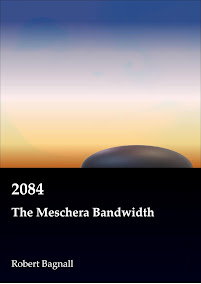

2084. The world remains at war.
In the Eurasian desert, twenty-year old Adnan emerges from a coma with memories of a strictly ordered city of steel and glass, and a woman he loved.
The city is the Dome, and the woman... is Adnan's secret to keep.
Adnan learns what the Dome is, and what his role really was within it. He learns why everybody fears the Sickness more than the troopers. And he learns why he is the only one who can stop the war.
Persuaded to re-enter the Dome to implant a virus that will bring the war machine to its knees, the resistance think that Adnan is returning to free the many - but really he wants to free the one.
24 0s & a 2

No comments:
Post a Comment